Universalis, About this blog

Sunday, March 02, 2014

An excellent visit with familiy back in the Philippines

Yes it was. Even if we all caught a bug somewhere along the way (no idea if it's Australian, Chinese or Filipino). K2 (Kid#2) weathered it best with just some hoarseness (didn't stop his horsing around). K4 (you get the picture) and I ended up with high fevers, headaches and antibiotics (I'm finishing my third course now). The missus has just stopped coughing a month after we all started. We missed a few visits to places and friends as a result. Probably a third of our 25-day journey was ruined to a certain extent.

But it was a great visit. One of my older brothers came home with his family from overseas. We got together with our sisters and their families. I visited my youngest brother and his family. Cousins got together across my generation and my children's. And of course, shopping in the Philippines is always good.

But this, I think, was what I loved the most: my kids mingling with cousins their age or a few years older, and aunts, uncles, grandparents, grand-aunts, etc, who spoiled them silly. It's that sense of being part of something much bigger that makes these trips worth the cost. Human beings are social animals, we are told. More - better - than that, though, I think we're always members of a family.

Freddie Mercury sang "who wants to live forever?" in the movie, Highlander, many years ago. It's a haunting question for which the answer entirely depends, I think, in whether or not you are isolated or live within a family. Living alone forever is terrible to contemplate. Living forever with a large, boisterous, messy, always interesting and entertaining family is something I'd like to do. Luckily, I need not think of it wishfully. I already am. :-)

Friday, January 10, 2014

Morality, Character and Practice Makes Perfect

Fr. Robert Barron has a fantastic short video on Word on Fire (Youtube) where he talks about the results of our actions, in particular where it concerns sexuality. I can'r find the video now but it appears to be in print form in www.catholiceducation.org/articles/philosophy/ph0056.htm, an article reprinted at Catholiceducation.org. He cites JPII's Love and Responsibility as a reference when he describes the less obvious outcome of every act. Yes, there is usually the obvious consequence, you usually can't miss it. A good example might be an unintended pregnancy, but Fr. Barron discusses the subtle consequences in that video, which might be trivialized or simply get overlooked. That is the gradual undermining of one's character in every act that adds up in the end. Like a bad habit a professional athlete might pick up if not too careful, it pays to note how it can bring that person to ruin in the end.

I often warn my kids: "practice makes perfect." I think this is a good way to explain this gradual erosion of one's moral character. St. Josemaria Escriva notes the Psalmist's imagery of "little foxes" that destroy the vineyard, and that has taken on greater meaning for me when considering, if I'm totally honest with myself, how I backslide and veer off-course gradually if I'm not paying attention.

Things add up: what exactly am I piling up for myself? Practice makes perfect: what am I perfecting? One step at a time: where am I headed anyway? One day at a time; one act at a time: who am I becoming?

Fr. Barron hits the nail on the head when he points our the fallacy of saying to oneself "but deep down inside, I'm a good person." Each act changes who that person is, deep down inside.

Saturday, December 28, 2013

That you too may be in union with us..

"as we are in union with the Father, and with his son Jesus Christ.." (1 Jn 1:1-4). The order is striking and noteworthy -- first is union with "us", the Church, Body of Christ, through which strangers are brought in as adopted sons and daughters of God, but the importance of the Church is implicitly underlined, I think. Not the clericalist Church that we seem to be outgrowing now, but all the Church, clergy and laity together, past, present and future. (Some other time, I shall better exp!ain what I mean about outgrowing clericalism.) As Christ was sent to draw all of Man back to God, so is his Body, the Church, sent to continue that work across the age.

Tuesday, December 24, 2013

This crisis of willingly absent and/or multi-familial fatherhood

.. and extended adolescence among men coincidental? Perhaps not. Perhaps there is a common thread. The late Robert Jordan intuits this in his Wheel of Time novels when he notes that the greatest feats of magic were when male and female worked them together. We need look no further than in the procreative design of humanity (and most of the animal kingdom). It has occurred to me before how the ingenuity of homosexual artists and fashion designers may well draw from the richness of both genders. Which makes it relevant to point out that both genders are to be celebrated for the genius of their respective natures, rather than pretending that there are no differences, or engineering society to make it so.

Thursday, December 19, 2013

When God says "no"

I can think of two examples, from St. Paul and Jesus himself, both praying earnestly for an end or abeyance of suffering. God said "no." To St. Paul he said "my grace is sufficient!" To his only begotten Son, completely innocent and undeserving of suffering, he sent an angel for comfort and strength.

I found myself at a familiar prayer, to be delivered from temptations that I have found particularly vexing for most of my life. There were years when I was safe, and months when I was not. I naturally prefer deliverance without a struggle. Partly because I dread the outcome, partly because I dread the struggle.

Thank God he said "no." A man's got to do what a man's got to do, lest, as in this case, one remains a lesser man, and I do want to be exactly, not one ounce less, who I be, in the timeless sense. Who am I? In the divine plan, one is answered in another: who is Jesus? Son of Man and Son of God, in him I find myself. And so when I ask that this or that unpleasant cup pass from me, I have my answer. Each "no" means "you can do this!" What hope he has in me! Thank God for such love and optimism for this wretch, who is not hopeless -- given such abiding hope so graciously and unbelievably placed in me!

An interesting note on concerted international lobbying

.. because it happens across many fronts that set things back for pro-life and traditional family interests as well, e.g., promoting abortion. In this case, it's copyright policies, but the methods are similar.

Tuesday, December 03, 2013

Why do people hurt one another?

And why do we do the dumbest things? Oh, yes, one refers to the other, and I am often guilty of both.

Anyway, I was struck by these lines from two of my favourite contemporary authors: Raymund Feist: "Feelings don't make sense, .. but they can drive us, and that's what you have to understand most of all. People will often do the most imponderable things because of how they feel, not because of what they think." Terry Goodkind's version is simpler: "Passion rules reason," but I think that needs unpacking.

Perhaps that is how Jesus on the cross could possibly say "Father, forgive them, for they know not what they do." It takes the most clear-sighted human being to see the limits of our humanity, which can mean that reason ends where passions begin, or where passion goes over the precipice. I often overreact when I feel slighted. I'd love it if that was the point when I'd remember: he/she did this really stupid thing because of emotion, not deliberate thought. And I should daily practice ruling my passion with calm, long-sighted reason.

Monday, December 02, 2013

Humanae Vitae still questioned today by theologians

I recently heard a theologian assert that Hmanae Vitae is not infallible teaching, although it is important. This seems to be a good read in support of the encylical: https://www.ewtn.com/library/Theology/AUTHUMVT.HTM. Sometimes, reading about arguments of this sort bring to mind one word: wrangling. Splitting hairs might also be apt. Such discussions are important, perhaps, but they can seem too academic. It reminds me of teenagers trying to wriggle out of what Papa had said. :-) (That was how we addressed our father, growing up: Papa. And we probably did that sort of wrangling then, too, at least some of the time!)

But following the evidence, and we have plenty of it, it does seem that Pope Paul VI was proven right for the most part, and I don't see that he was wrong anywhere.

Tuesday, November 26, 2013

Of the Fewness of Those who love the Cross of Jesus

From The Imitation of Christ:

Jesus hath many lovers of His heavenly kingdom, but few bearers of His Cross. He hath many seekers of comfort, but few of tribulation. He findeth many companions of His table, but few of His fasting. All desire to rejoice with Him, few are willing to undergo anything for His sake. Many follow Jesus that they may eat of His loaves, but few that they may drink of the cup of His passion. Many are astonished at His Miracles, few follow after the shame of His Cross. Many love Jesus so long as no adversities happen to them. Many praise Him and bless Him, so long as they receive any comforts from Him. But if Jesus hide Himself and withdraw from them a little while, they fall either into complaining or into too great dejection of mind.

Who could ever love a cross, an instrument of torture? It came to me that "love" is not "a warm feeling of delight" after all. It is an exercise of the will to decide when something has to be done. We will not like the cross, but sometimes, we will want it for what taking it up will accomplish. Perhaps it will actually be for the good of the other.

Should critics of the Church who take themselves too seriously be taken seriously?

By such description, I do mean critics who seem to disparage their subjects with great wit and, as I pictured it, a wink and a smug smile. I didn't make it through the Introduction before noticing such a habit from "Ten Popes who Shook the World." Describing somone as being "of limited intelligence" easily gets me. I would have thought that a highly esteemed scholar would be beyond such things. Not that I'm beyond uncharitable comments and thoughts, either. Pride is perhaps at the root of many sins of mine, some quite habitual. But I'm not a published writer of such works. I am certainly no professor. I probably do lack confidence in conducing myself in many ways, but I don't think I could do with more arrogance. Less, in this case, when offering critiques of another human being, is definitely best.

Wednesday, November 13, 2013

Neither feared death nor refused to live

It is written of St. Martin of Tours that he neither feared death nor refused to live. While happy to die so as to meet with Christ forever in Heaven, he was willing to continue a life of toil and austerity, and no small amount of pain in his old age. What makes one unafraid of death? Hope, which lends confidence, found in faith, that Christ is at the end of a virtuous life of fidelity; Christ and his promised eternal happiness. What makes one willing to live in continued toil? Love, obliged by the love one has been given by God completely by grace, one might remain to serve those in need even when rest from one's labors is sought and perhaps due. How far am I from such faith, hope and love, whom selfishness and anxiety still rule so frequently in my words, thoughts and actions! May I attain little by little, daily, unto the fearlessness and generous heart of St. Martin of Tours, of Christ my Lord!

Sunday, October 27, 2013

Baptisms falling

And perhaps it has to do with falling rates of weddings as well. And with premise of the orthodox understanding of baptismal regeneration, this derth does not bode well.

Saturday, October 26, 2013

Them's fightin' words from Pope Francis

.. we must make the effort to walk on the path of righteousness, sanctification - use this word: holiness.. .. Before the Act of Faith, prior to acceptance of Jesus Christ, who has created us anew with His own blood,” explained Pope Francis, “we were on the road of injustice.” After Baptism and the Act of Faith, however, “we are on the path of sanctification, but we must take it seriously! Without this awareness of the before and after of which Paul speaks to us, our Christianity does not help anyone! More to this: it takes us on the road of hypocrisy. ‘I call myself a Christian, but live like a pagan!’ Sometimes we say ‘Christians at half-speed'

Homily 24 October, focusing on the universal call to holiness

Thursday, October 17, 2013

An excellent examination of conscience

by Father John Hardon, SJ, that seems very balanced to me. One of these days, I shall write a bit about what I have been learnng by God's grace, but for now, let me say how important such balance between sorrow for joy is.

Monday, October 14, 2013

What accomplishments matter

Not the failed attempt at reviving my XP on Bootcamp, despite hours of fiddling with it to the wee small hours. No sense of accomplishment there. Then I lie down and look at my daughter next to me (sleeps between mom and dad), and there's someone to make me smile -- and she's not even my accomplishment. I'm just a happy receiver of God's gifts! :-) Thank you!

Sunday, October 13, 2013

Your faith has saved you..

Today's gospel narrative has Jesus curing ten lepers thrown together by a common lot of disease and being outcasts. Only one, the foreigner Samaritan, is moved to gratitude and touched by God inside and out. He is perhaps overcome with the realization that Jesus wasn't just a man. He praises God loudly and throws himself at Jesus' feet. Our deacon made the point about this episode and the work of evangelization that we are called to, without exception (but with variety, I guess). But he also makes the point that we cannot evangelize unless we ourselves were touched with such overwhelming love and realization of having received God's grace. How often have I ever felt the cured man's elation and overpowering joy? It is not as if I hadn't received such mighty gifts -- my wife, who puts up with so much; my kids, when I know of many who have not been blessed with any. It is easy to take them for granted, these mighty gifts from God, especially my wife's daily gifts of love, day in and out. So that is why St. Paul exhorts several times to thanksgiving, which is to live in this truth: God loves me, God in whom I live and have my being. That I can own that truth, when for most of my life, I could not, means that I should be ready to evangelize, when it is now more than head-knowledge. It is now conviction. (Great, another would-be Evangelical Catholic online!)

There is a battle going on..

I know Pope Francis has seemed horribly off the cuff lately, resulting in a lot of consternation from orrhodox Catholics, but I guess I'm not so fussed when I'm already in skeptic mode -- skeptical of what mainstream media claim he says. And of course it is worrying when he seems vague or ambiguous enough to be misunderstood by those still new or immature in the faith, but I think we're at this point in history where being uninitiated in the faith is no longer easily excusable. In this age of massive online literacy, who can claim ignorance in the faith? The Catechism is online. The Bible is online. Catholic Answers is online. EWTN is onlne. Father Z, jimmy Akin, Tim Staples, Mark Shea, Scott Hahn -- heck, your bishop is online. Even the saintly departed like Bishop Fulton Sheen, Chesterton, C. S. Lewis, Blessed Pope John Paul II, and many of our saints are online. "Do not be naive.. There is a battle .. where salvation is at play.." Every Christian must be ready, forearmed with knowledge of the ways of the Enemy and of The Way.

Sunday, September 22, 2013

The 99 lost sheep

Phil Lawler writes the above as the key to understanding Pope Francis who stirs things up even for orthodox Catholics. His interview with America magazine seems to suggest a leniency on certain doctrines, but, perhaps like Mr. Lawler, I see a stronger emphasis on mercy, but in no way is it giving up on justice. I think it's a chronological order that makes more sense when the lost 99 sheep are no longer engaged in dialogue. Mercy before justice sounds right: justice built on the foundation of mercy and grace.

Personally, God's hand has been on me over the last few years, starting with MenAlive, which puts things in that order. I had to know what I'd been told time and again (but wasn't listening), that God loves me and grants me his mercy. This gets my attention so I'm able to listen. It gives me hope so I can rouse up, and gives me confidence so I may act. It also fills me with knowledge of his grace, so I can gratefully give back and pass it on.

This sounds like what the Holy Spirit is stirring up through Pope Francis. Sounds like Good News to me!

Friday, September 13, 2013

Mind your own business .. Was that how Jesus put it?

Political correctness seems to suggests that we are not to correct one another for the sake of individual freedom, perhaps. It is even suggested that the real Jesus teaches us to live and let live.

This text might be suggested: "Why do you observe the splinter in your brother’s eye and never notice the plank in your own? How can you say to your brother, “Brother, let me take out the splinter that is in your eye,” when you cannot see the plank in your own? Hypocrite! Take the plank out of your own eye."

But that cuts out the next part of that sentence. Here it is in its entirety:

Take the plank out of your own eye first, and then you will see clearly enough to take out the splinter that is in your brother’s eye.’

So according to the whole sentence, indeed the according to the whole parable, it's not a prohibition to correct someone when necessary to do so. Rather, it is a practical preparation for doing so, in order to be more effective at it. That's actually important, because true charity means willing the other's good, rather than abandoning him/her to whatever he/she prefers, and its periils. It's never pleasant, especially on the receiving end, but if I'm about to walk off a cliff, I'd rather be warned about it.

(Ref: Luke 6:39-42, from Universalis.com)

Wednesday, September 11, 2013

Baptism and Circumcision

From Colossians 2:6-15 (first reading Tuesday this week):

You must live your whole life according to the Christ you have received – Jesus the Lord; you must be rooted in him and built on him and held firm by the faith you have been taught, and full of thanksgiving. Make sure that no one traps you and deprives you of your freedom by some second-hand, empty, rational philosophy based on the principles of this world instead of on Christ. In his body lives the fullness of divinity, and in him you too find your own fulfilment, in the one who is the head of every Sovereignty and Power. In him you have been circumcised, with a circumcision not performed by human hand, but by the complete stripping of your body of flesh. This is circumcision according to Christ. You have been buried with him, when you were baptised; and by baptism, too, you have been raised up with him through your belief in the power of God who raised him from the dead. You were dead, because you were sinners and had not been circumcised: he has brought you to life with him, he has forgiven us all our sins.

Monday, September 02, 2013

Not peace but a sword

In World Youth Day recently, Pope Francis asserted that we are called to shake things up, to be messy in evangelizing the world. How messy can we be if we are called to be meek and humble? How so was Christ? In today's Gospel from Luke (4:16-30), he starts out with "gracious words" --

The spirit of the Lord has been given to me, for he has anointed me. He has sent me to bring the good news to the poor, to proclaim liberty to captives and to the blind new sight, to set the downtrodden free, to proclaim the Lord’s year of favour.

Nice start, but then he shakes things up --

‘There were many widows in Israel, I can assure you, in Elijah’s day, when heaven remained shut for three years and six months and a great famine raged throughout the land, but Elijah was not sent to any one of these: he was sent to a widow at Zarephath, a Sidonian town. And in the prophet Elisha’s time there were many lepers in Israel, but none of these was cured, except the Syrian, Naaman.’

I don't like confrontations. It's messy, but seems to me that I have no choice if I am to follow my Master. Last week he was hurling "brood of vipers!" and "hypocrites!" at certain authorities in his time. I would hate to be on the receiving end of that, but what if there is need to correct my brother or sister or child if they were risking something perilous to their lives? God help me say what needs saying with true love, which must sometimes be tough love (for their sake!), But I truly would prefer if I can speak with gentleness in my voice, even if the words must be unyielding and inevitaby shaking things up.

Most of all, may those who love me speak so to me when needed, which is very often, and may I have the honesty and humility to take their words to heart, and so amend my life as it depends on my willingness to be corrected!

This is apt from The Imitation of Christ (from today's Office of Readings), spoken from the Lord's perspective:

I visit my elect in a double fashion: that is, with temptation and with consolation. And I read to them two lessons each day: one to rebuke them for their faults; the other to exhort them to increase their virtue.

Saturday, August 24, 2013

A Christian without the Cross?

I think we'd be mighty odd Christians if that.

(Lk 9:23) And he said to all, If anyone would come after me, let him deny himself and take up his cross daily and follow me.

Someone wrote someplace, "love until it hurts" or maybe "it ain't love if it don't hurt." And who can forget that eloquent rock ballad, "Love Hurts" of decades ago? But what's love got to do with the cross? Everything -- just take a look at your nearest crucifix, or single mother or father getting by somehow, the heroic son or daughter caring for their ailing parent. They're everywhere, these cross-carrying heroes, imitating the one whose sacrifice is one with theirs, making theirs worth it (and doable).

Tuesday, August 20, 2013

Finding the child at the Temple

I am learning something that is both simple and profound about faith, which is that, indeed, to children belong the kingdom of heaven. It came to me, as I prayed the fifth joyful mystery of the holy rosary, that one must relax and take small steps, and be uncomplicated as a child. The child in that episode is Jesus, about his Father's business, but doing what? At the Temple, he was (Lk 2:46) "sitting among the teachers, listening to them and asking them questions." That was the time for a child to listen and ask questions.

I, too, must be about my Father's business but how? I won't be writing the next Apologia, nor start being a catechist without training, much less a deacon. I need teachers; I need to listen and ask questions. I need to clean up my act as husband and father first. And I think I should see my spiritual director again. It's been a few months.

"Keep Thou my feet; I do not ask to see the distant scene; one step enough for me. I was not ever thus, nor pray'd that Thou shouldst lead me on; I loved to choose and see my path, but now lead Thou me on!" (From a hymn by Blessed John Henry Newman.)

Tuesday, August 13, 2013

Greatness bestowed

It seems to make no sense to view greatness in these terms: receive, learn, partake, obey, imitate, follow. Yet these are the paths to greatness, for Greatness is a person: God, and we cannot therefore take it upon ourselves. Yet this God bestows himself on those who are willing to receive him, and it takes a child's heart to receive on the giver's terms, not in the way the world thinks of what makes for greatness (Gospel today: Matt 18:1-14). And so he teaches: "whoever humbles himself like this little child is the greatest in the kingdom of heaven."

These antiphons from tonight's Evening Prayer are most illuminating, when taken together:
The Lord surrounds his people with his strength.
Unless you acquire the heart of a child, you cannot enter the kingdom of God.

It is by God's wonderful grace that this is penetrating my mind now -- took me long enough! -- and it fills me with such excitement and hope!

Tuesday, August 06, 2013

The promise of the Transfiguration of the Lord

.. is a promise of his glorious resurrection -- and ours. In today's evening prayer in the Liturgy of the Hours, the concluding prayer, formulated over the centuries of wisdom granted by the grace of God, goes:

O God, who, in the glorious Transfiguration of your Only Begotten Son, confirmed the mysteries of faith by the witness of the Fathers and wonderfully prefigured our full adoption to sonship, grant, we pray .. that, listening to the voice of your beloved Son, we may merit to become co-heirs with him.

and the reading quotes from Romans 8:16-17.

The Spirit himself gives witness with our spirit that we are children of God. But if we are children, we are heirs as well: heirs of God, heirs with Christ, if only we suffer with him so as to be glorified with him.

and so we pray with "the hope of being transfigured at the last day," always by the grace of God!

Friday, August 02, 2013

If you have confident hope in the Resurrection of the dead..

.. then how can we not hope that we can keep to our marriage commitment, a sacrament, a covenant blessed by God?
The thought came to me as I prayed the fifth sorrowful mystery of the rosary, the Crucifixion, which is at the core of our Christian faith. How can this horrible event and scene be at the core of what we believe, witness to, exult in and celebrate? How? because this isn't the last scene. There is the Resurrection. And so one may dare - must dare - to hope beyond what society might say is beyond hope, and to live that hope, commit action and decisions to that hope. To do so on thoe grounds just makes sense..

Wednesday, July 31, 2013

The making of a saint

In today's Office of Readings, this is written of St Ignatius de Loyola:

Ignatius was passionately fond of reading worldly books of fiction and tales of knight-errantry. When he felt he was getting better, he asked for some of these books ... But no book of that sort could be found in the house; instead they gave him a life of Christ and a collection of the lives of saints ...
By constantly reading these books he began to be attracted to what he found narrated there. Sometimes in the midst of his reading he would reflect on what he had read. Yet at other times he would dwell on many of the things which he had been accustomed to dwell on previously. But at this point our Lord came to his assistance, insuring that these thoughts were followed by others which arose from his current reading.
While reading the life of Christ our Lord or the lives of the saints, he would reflect and reason with himself: “What if I should do what Saint Francis or Saint Dominic did?”

I've often lamented that my children are not given so much readings from the lives of the saints and from divine Scripture. Instead, they bring home cute and amoral stories of trivial value. It falls on us, parents, to correct this, I think, for our children will not fail to look for models to emulate, and the heroes and idols of this generation are often wanting, to say the least. The Word was made flesh long ago, and he remains incarnate in his Church, in the deeds of his saints, written in their lives and their writings. This is so he continues the discourse, in whatever age, to tell us that he loves us, and his love saves us no matter what comes. But what happens to our children if we do not give them every opportunity to listen at his feet? Worse yet, as nature abhors a vacuum, what lessons are they listening to instead?
And not to forget (almost did), what of myself?
St. Ignatius de Loyola, pray for us!

Friday, July 26, 2013

The gift of fatherhood

Parents of my eldest son's class were asked to write a letter to our sons that they are to open at camp. Writing mine, it reminded me of what a wonderful gift fatherhood is -- to me! In this, I was given insight into the heart of God himself, into the heart of fatherhood. I was given insight as well into my own heart, both where his grace and my shadows were apparent. I was entrusted with this wonderful human being, my son (and my other children), despite my frequent bouts with moodiness, grumpiness and foolishness. Yet was I trusted with so many arrows in my quiver. How gracious is God! St. Joachim and Ann, pray for this foolish father, that I may not mess my children up too much even as God brings them up through me. Amen!

Sunday, July 14, 2013

On Ireland and the Philippines

CatholicCulture.org publishes two interesting articles on the recent developments in these countries:

It is no coincidence that both countries have been bowled over by controversial legislation on matters of marriage and family, and the sanctity of human life. These are the most remarkably Catholic countries in their respective regions. Being Catholic these days means a notable distinction in our views these matters. In many ways, this is a sad distraction from the new evangelization, but perhaps it speaks volumes about the centrality of human life and marriage to the orthodox Christian life. Mess with those and what does one end up with?

Friday, July 05, 2013

A thought that struck me on the Carrying of the Cross

.. is this: why did Jesus bother? If the strict requirement for the redemption of humanity was his sacrifice on the cross, then why the extra mile in agony? I'd have happily fainted and let them take me to Golgotha unconscious. They were going to kill me anyway!

Maybe he did it because that agony was efficacious in other ways.

Maybe he carried the cross because we would have to carry ours. By carrying his cross, maybe it makes it *possible* for us to carry ours as a supernatural act of love, with supernatural fruits for eternity, because we'd be carrying ours with him.

Who can avoid the cross anyway? If we wish to be his disciples, why would we want to?

There was a striking line in Mel Gibson's "The Passion of the Christ" that one of the thieves uttered: (paraphrased) why do you embrace your cross, you fool?

We'd be fools with Christ for embracing our daily cross with him, not because either of us are eager for pain as its own good, but because it is inescapable at times when we love others, because love hurts indeed.

And so the king of love carried his cross, so that we need not fret that our agony is wasted when we carry ours: how can it, when it is united with him and his act of redemptive love?

Monday, June 24, 2013

Faith and effects of good and bad reading

I'd recently heard a podcast from Audio Sancto of the same title ass above, and I was struck by how subtle indeed is the damage that can result from the exaggeration of the ills of the Church in what we read. I liken it to the imbalance in what we appreciate in our children. If all we appreciate and mull continuously are their mistakes and faults, as I frquently do (mea culpa), then we would miss the greater half, the marvels of their being and promise for the future. Perspective is what we need, and it can be hard to find when one is a pessimist, always on edge and ready to see woes and hard-pressed to see the wonders that are there to see. Blessed are the humble who do not live by expectations!

Sunday, June 23, 2013

One in Christ

"You are, all of you, sons of God through faith in Christ Jesus. All baptised in Christ, you have all clothed yourselves in Christ, and there are no more distinctions between Jew and Greek, slave and free, male and female, but all of you are one in Christ Jesus. Merely by belonging to Christ you are the posterity of Abraham, the heirs he was promised." (Gal 3:26-29) May all Christians be truly so Christ-centered, with a clarity as to who Jesus Christ is, the Son of God, that what divides us will be as nothing to what unites us in the one baptism that calls us to live as sons and daughters of the one God Most High under his one family, one Church!

Monday, May 27, 2013

The Truth, The Lie and the Last Battle - Troy Hinkle

Troy Hinkle posts his reflections on current events in comparison with C. S. Lewis' "The Last Battle", and he hits a few home runs, I think. When I read that last Narnian book years ago, and when I read it again more recently, I remember that the unfaithful dwarves struck me the most: their cynicism and apostasy after having being confronted with the truth, their disillusionment and weariness from Shift's lies, they filled me with no small amount of dread because their reaction was understandable. I remember thinking, Who can blame them? But then I realize as well that they are not innocent of wrongdoing either. There is something wrong with the fact that they went along with atrocities that they would surely have known to be evil acts. Sure, they got tired of the lies that had caused their lives so much bitterness and injustice, but they also got so lazy that they were no longer interested in the truth -- and that is something we must never tire of seeking: Truth. No matter how bad things get, we must never think that the truth no longer matters. It always matters, and it does exist! The great irony is that many who would claim to be enlightened, rational intellectuals contradict this truism by subscribing to relativism.

Monday, May 13, 2013

Catholic growth in US Bible Belt states

according to this NCRegister article. This remarkable observation from someone in the area struck me: 'it is easier for Northern Catholics to take their faith for granted because most of their friends belong to the Church. “It doesn’t really challenge the Catholics there to know their faith as well or be able to explain it clearly..'

Challenges can be very good for the faith, no?

Saturday, May 11, 2013

Coptic Pope stresses urgency of Christian unity at Vatican :: Catholic News Agency (CNA)

"The Pope of the Coptic Orthodox Church of Egypt met with Pope Francis at the Vatican and spoke about the urgent need for unity among Christians in the Middle East. “We must prepare our people for this very real and needed unity that we know and live, we must work quickly and seriously,” said Pope Tawadros II in May 10 remarks provided to CNA by his office." More from the Catholic News Agency (CNA)
When I read stories like these, I often wonder how the world would have fared if we were able to live the unity of one Church on earth that Jesus prayed so fervently for (Jn 17):

.. Holy Father, keep them in thy name, which thou hast given me, that they may be one, even as we are one. .. "I do not pray for these only, but also for those who believe in me through their word, that they may all be one; even as thou, Father, art in me, and I in thee, that they also may be (one) in us, so that the world may believe that thou hast sent me. The glory which thou hast given me I have given to them, that they may be one even as we are one. I in them and thou in me, that they may become perfectly one, so that the world may know that thou hast sent me and hast loved them even as thou hast loved me.

Christian Hip-Hop?

The cover story at Christianity Today asks if Christian Hip-Hop can call American church back to the gospel -- not referring to Catholics, of course. My first thought was that this cannot posibly fit into liturgy, but, to be fair, Evangelicals do not share the original meaning of the word "liturgy" anyway. I suppose that any form of art, if truly uplifting and inspirational, can be used to glorify God. Setting word to rhyme can be good for many, but never in the Eucharistic celebrations of the Mass, of course. I've often thought that a Catholic parish that is Christ-centered in the Eucharist primarily, and the other sacraments, can bear much fruit with other communal celebrations, including prayerful song -- maybe even Christian hip-hop, -- outside of the Mass. Thoughts, anyone?

How the West Really Lost God -- Dr. Mary Eberstadt

How the West Really Lost God | Crisis Magazine -- Austin Ruse summarizes a remarkable thesis, perhaps unheard of, that the West lost its faith beginning with the weakening of the family as an institution. It is worth considering that a moment (and even more so, reading Dr. Eberstadt's book. Raising a family is indeed challenging to one's faith, and the size of that family is proportional to the challenge, but does faith not grow stronger, by God's grace, the more it is challenged? Indeed it does, as anyone who has allowed oneself to be challenged would know. No pain, no gain, right? We mature with every challenge that we meet (and perhaps fail to mature with every one we run away from -- assuming there was a choice). My children being young, I know there is so much more awaiting us than my wife and I have already encountered. But these, so far, with deep gratitude for the assistance of God and the loving friends and family he has surrounded us with, have both challenged and enriched us. How we get by is no small miracle.

And such contempt for big families, by the way, is no longer unexpected even here in Melbourne. The mindset of two-children families appears to be typical fare. We get stared at openly when we have all four children with us out and about. It no longer bothers me. My wife has been told more than once that we have too many -- four kids!

Thursday, May 09, 2013

Learning to love Heaven

It’s not as automatic as you think , according to Msgr. Charles Pope. Indeed, if Heaven is a place of complete happiness, then everything Jesus said about that in the Beatitudes must be front and center. As I have much to learn about being meek and poor in spirit, having hunger and thirst for righteousness, loving peace, purity of heart, entrusting my heartaches and grief to God and perseverance in persecution, then I have a lot of work and learning to do, and who knows how much time I have left?

Friday, May 03, 2013

Reflections on the Crucifixion: the Other thief

We often cite the good thief on the cross next to Jesus as a good example of repentance and of Christ's mercy, but something about the other thief struck me today as I meditated on the fifth sorrowful mystery of the holy Rosary. The taunts and desperate pleas of the unrepentant thief seemed to me akin to the temptations we face, sometimes daily, to walk away from our commitments to our spouse, our family, to love them regardless of the circumstances we find ourselves in. I know these temptations well, and it doesn't have to be about walking away completely. Even walking away from today's commitment to be supportive, to be patient, that already falls into this mindset of 'me' rather than 'them' who depend on us. Yes, we may be in great pain, and what would it cost to give ourselves a little comfort, a break from our commitment, even for just a day? Nothing wrong unless it costs our family something that they truly need. What that might be would vary, but I am keenly aware that the small breaks I give myself, by shutting out my family just a bit can, little by little, accumulate towards aloofness, alienation, indifference. If I could find a way to give myself a break while maintaining good relations with them, such as in playing a game with my children that I enjoy as much as they do, I should. But to shut myself away at a moment when they need me -- that may well be the beginning of walking away. Christ on the cross would have been tempted to at least ease his pain a little -- he did not deserve any of it, after all. Why didn't he? Here was a man truly committed to his Bride, his Church; to the family he gathered to himself. He didn't deserve any of the pain he endured at the hands of our sins, but he took it upon himself to defeat it by embracing it to the very end, every lash and cut and bruise, every spit and insult -- and every temptation to walk away, and he stayed the course. Why? So that sin would be crushed completely, absolutely, even to the last loose end. In other words, to make for total victory. I believe that we who are united with him in his body and Holy Spirit are called likewise to such a battle and absolute triumph. When we hear the taunts, or even the reasonable suggestion to give ourselves a break, we should consider what it costs the ones who depend on us and whom we are called to love. Perhaps with a little creativity, with due consideration for our need for a break and their need for our love, we can find a middle ground, one that does not sacrifice their needs and our commitment for the sake of wanton selfishness. Not that it would be easy, but we are not called to go easy. We are called to be faithful, loving and confident in hope.

Saturday, April 20, 2013

The Justice of God: a glmpse

The twenty-four elders.. touched the ground with their foreheads worshipping God with these words, ‘We give thanks to you, Almighty Lord God... The nations were seething with rage and now the time has come for your own anger, and for the dead to be judged, and for your servants .. all who worship you, small or great, to be rewarded. There is no peace without justice, but what happens to us if God's justice were given immediately after we sin? Rather than immediacy, God exercises patience, giving time for mercy, because (1) He is love, and (2) we are beings of time. On the latter, God designed us gto be dynamic beings whose fathom can only be appreciated over time. To God, who sees all time as an instant, our sin at one moment is not the end of the story therefore. Many find the existence of evil in the world to be in contradiction to the existence of a God who is love. But seen in the light of finiteness and time, it isn't a contradiction at all. God bides his time because the ultimate salvation of man comes from mercy, and mercy plays out for the sinful by repentance and conversion, both being acts done in time.

Friday, April 19, 2013

Reflections on the First Three Luminous Mysteries of the Holy Rosary

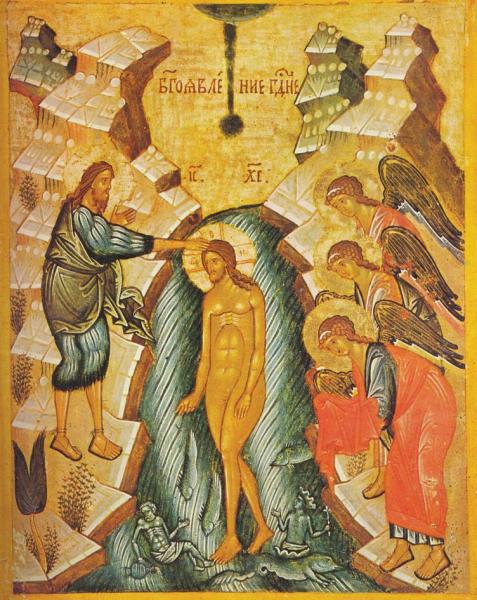
The Baptism of the Lord in the Jordan -- the beginning. He does not need the regenerative washing, but we need him to institute this sacrament of initiation. The Spirit samctifies the water for Baptism, the Father's blessing with words of election: This is my Son, Beloved, in whom I am well pleased. The Son of Man, the Son of God, stands in our place as the Truly Worthy, making us worthy to be so called into the family of God. Then the Wedding Feast at Cana: our Blessed Mother notes the lack of wine, asking her son implicitly to intervene as only the true Bridegroom could. Do not belittle the need for this sign! The last two generations have done much to ridicule the dignity marriage -- and look at how the children have had to pay for it in tears and broken spirits! In the Lord's place, I too should like to be warned when the wine of light-heartedness should run low. Being a husband, I should then do something about it when it happens: Do whatever he tells you. The Bridegroom should know more than anyone what is best to do then. I must care for my marriage first of all. It must be a constant celebration of love: God's love, the source and template for all human love. Then the Proclamation of the Gospel. Anointed at Baptism, grounded firmly on love in my marriage, I should then proceed boldly to mission: proclaim, set free, to heal and bind up -- by God, I am equipped for every good work. Forth! Faith! Love!

Tuesday, April 02, 2013

Without grace we can do nothing!

Translation of Pope Benedict's address on Monday of Easter:

"Indeed, the Baptism that makes us children of God, and the Eucharist that unites us to Christ, must become life. That is to say: they must be reflected in attitudes, behaviors, actions and choices. The grace contained in the Sacraments of Easter is an enormous source of strength for renewal in personal and family life, as well as for social relations. Nevertheless, everything passes through the human heart: if I allow myself to be reached by the grace of the risen Christ, if I let that grace change for the better whatever is not good in me, [to change whatever] might do harm to me and to others, then I allow the victory of Christ to affirm itself in in my life, to broaden its beneficial action. This is the power of grace! Without grace we can do nothing – without grace we can do nothing! And with the grace of Baptism and Holy Communion can become an instrument of God’s mercy – that beautiful mercy of God."

Monday, April 01, 2013

Which comes first: faith or grace?

Was Easter God's response to the faith of the people of Israel? Does God give the grace of his salvation with the faith of the Christian believer?

The Easter grace of Baptism

The grace of Easter applies today most intimately in the sacrament of Baptism, but many Christians postpone this grace unnecessarily. These were from the Office of Readings today:
  1. From Ex 14:15-15:1, Moses stretched out his hand over the sea and, as day broke, the sea returned to its bed. The fleeing Egyptians marched right into it, and the Lord overthrew the Egyptians in the very middle of the sea. The returning waters overwhelmed the chariots and the horsemen of Pharaoh’s whole army, which had followed the Israelites into the sea; not a single one of them was left. But the sons of Israel had marched through the sea on dry ground, walls of water to right and to left of them. The passage across the sea, or the salvation of Noah and all aboard the Ark, have been cited Biblically and by Church Fathers as a clear type of Christian baptism: the waters that bring death and new life.
  2. From an antiphon today:
    O God, through the light of the New Testament you have revealed to us the meaning of the miracles you performed in the earliest times.
      The Red Sea was a symbol of the baptismal font,
      and the people freed from servitude prefigured the sacraments of the Christian people.
    Grant that all nations who have receive Israel’s privileges as a reward for their faith
      may be regenerated by sharing in your Spirit.
    Through Christ our Lord,
    Amen.
  3. From Ezekiel 36:16-28,  I am going to take you from among the nations and gather you together from all the foreign countries, and bring you home to your own land. I shall pour clean water over you and you will be cleansed; I shall cleanse you of all your defilement and all your idols. I shall give you a new heart, and put a new spirit in you; I shall remove the heart of stone from your bodies and give you a heart of flesh instead. I shall put my spirit in you, and make you keep my laws and sincerely respect my observances. You will live in the land which I gave your ancestors. You shall be my people and I will be your God.
  4. From Psalm 41(42), 
    Like a deer that longs for springs of water,
    so my soul longs for you, O God.
    My soul thirsts for God, the living God:
    when shall I come and stand before the face of God?
  5. From Romans 6:3-11,
    When we were baptised in Christ Jesus we were baptised in his death; in other words, when we were baptised we went into the tomb with him and joined him in death, so that as Christ was raised from the dead by the Father’s glory, we too might live a new life.
    If in union with Christ we have imitated his death, we shall also imitate him in his resurrection. We must realise that our former selves have been crucified with him to destroy this sinful body and to free us from the slavery of sin.
What a mighty gift, the Easter grace, that is being delayed and, in some cases, the opportunity is forever lost, through a horrible and quite recent misunderstanding of the doctrine! May God who wills to gather us all into his one family in a new life make us faithful to his most perfect and holy will!

Further reading; Infant baptism was already a practice in the second century AD.


Wednesday, March 27, 2013

A disciple's tongue, a disciple's ears and a disciple's heart

From Isaiah 50: "The Lord has given me a disciple’s tongue. So that I may know how to reply to the wearied, he provides me with speech." Words are powerful indeed, but for what? I think Isaiah hits a few good points: to encourage, to strengthen, to confirm, to comfort, to counsel, to console, to love the weary in their misery. But I can't give what I don't have, and so on top of a disciple's tongue, I need a disciple's ears, in order to learn from the Master, the Word of God. But can one know the meaning of love without enduring pain for the sake of love? So I also need and a disciple's heart, to know the Sacred Heart of Christ on the cross, he who is the love of God in human flesh. And then, my words become action: they become love, to comfort, console, to strengthen, and to aid. Then the disciple's words are made flesh, and God, who is love dwells among us,

Thursday, March 14, 2013

We have a pope!

By the grace of God, we have Pope Francis, by all accounts a humble shepherd of faith. It has occurred to me before that when Jesus gave authority to his apostles, and in particular St. Peter, there came with it an inherent duty of love from the sheep to actually listen to their shepherds. It is easy to point a finger at the pope and blame him for everything or expect everything from him, but we do forget how that might actually work... St. Francis Xavier, St. Francis of Assissi, pray for Pope Francis!

Wednesday, March 13, 2013

Sunday, March 10, 2013

To become the righteousness of God in Christ

This phrase from St. Paul (Cor 5:17-21) puzzles me. How can we become the righteousness of God? The context is that of having been reconciled to the Father through the Son: we who were estranged from Him are now his sons. But who can be His son who is not righteous as He is? A son inherits the Father's traits beyond mere similarity, so our inheritance must be truly intimate. In our adoption as His sons through Jesus, whose flesh becomes our flesh and whose blood becomes our blood, we truly do become his sons, and thus, we are his righteousness too, in Christ, who is the righteousness of the Father. And this is instrumental in our role as ambassadors of Christ in the same text: we minister reconciliation to the world who is still estranged to the Father, and we can only do that effectively if we ourselves are the message of reconciliation. How? Because we have been reconciled to Him already, and this is the powerful witness that we bring with us. How do we witness to reconciliation? We must therefore be compassionate as the Father, merciful as the Father is -- in short, we must be witnesses of love, peace, forgiveness -- all being characteristics of God who is love. It is therefore paramount that we who bring the message of reconciliation must shown ourselves to live in peace -- not simply the absence of hostilities but also the presence of communion, the communion of saints (both here and in Heaven). In the movie, "Jesus of Nazareth," the actor paraphrases somewhat when he speaks of the greatest commandment, that there is a second that is just as important as the first, the second being to love your neighbor as yourself. How can this be just as important? Because one loves God completely by loving neighbor as oneself. It makes even more sense if you consider your neighbor as another Christ, who said that whatsoever you do to the least of these brethren of his is done to him as well..

Sunday, March 03, 2013

Justice and Mercy

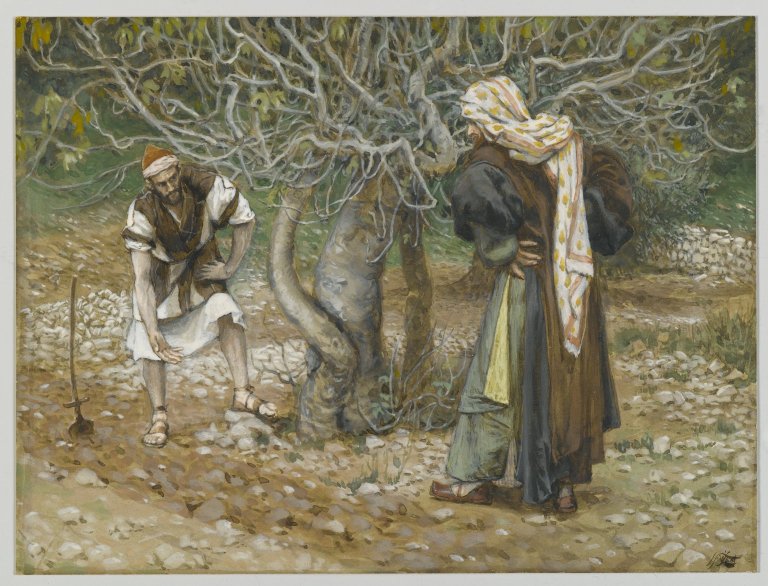
The parable of the fig tree
The parable in the gospel reading for Laudate Sunday, from St. Luke (13:1-9), is a magnificent portrait of God's justice and mercy meeting in the perfect middle:

He told this parable: ‘A man had a fig tree planted in his vineyard, and he came looking for fruit on it but found none. He said to the man who looked after the vineyard, “Look here, for three years now I have been coming to look for fruit on this fig tree and finding none. Cut it down: why should it be taking up the ground?” “Sir,” the man replied “leave it one more year and give me time to dig round it and manure it: it may bear fruit next year; if not, then you can cut it down.”

We are living that year of favour, and our divine gardener is ever so diligently fertilizing our souls with grace. If we would only appropriate (borrowing from Fr. Raniero Cantalamessa and St. Bernard) this grace that he freely gives! If we had faith but the size of a mustard seed .. !

In the barque of Christ

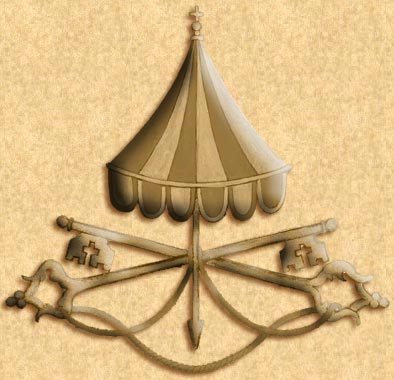
The Sede Vacante symbol
.. we hear St. Peter speaking, not as flesh and blood reveals, but as God reveals, as with this gem of a Petrine utterance:

"I always knew that the Lord is in the barque, that the barque of the Church is not mine, not ours, but His - and He shall not let her sink. It is He, who steers her: to be sure, he does so also through men of His choosing, for He desired that it be so."

In these days when the episcopal See of St. Peter is vacant, are we in the same boat as the Orthodox, or the Protestants? No, I do not think so. For we expect the resumption of the norm established by the Apostles. We do not take this situation as normal, to have no pope. And even so, we had popes, the most recent one still alive at that, and his pastoring does not disappear with his abdication, nor that of his predecessors. It is a moment of silence when he utters nothing for the meantime. For now, Peter rests. When the time comes, he will rise up again, to teach again with the keys of the kingdom; to strengthen his brother bishops; and feed the flock in the Petrine way.

Monday, February 18, 2013

I will adopt you as my people..

The question I used to hear from Evangelicals, "Have you accepted Jesus as your personal Lord and Saviour," baffled me at first. What a novel thing, I thought. My experience as a cradle Catholoc had always been more wholesale than personal: a family, a parish, the Church in the country, the whole Church throughout the world, and that through all time all the way back to Adam and Eve. Why personal? It dawned on me many, many years later that taking the personal view is no bad thing. One could miss the trees for the forest, although one might also miss the forest for the trees. Being Catholic, I cannot help but see the both-and approach as being more complete: Kata Holikos. The Old Testament scriptures are fairly explicit on God's relationship with his people as the overarching theme of revelation, and looks ahead to including all nations beyond Israel as his people. Even the New Testament is reasonably clear as well: the Greeks being the people beyond Judaism. Does that mean we lose the personal context? Not at all, because God cannot be limited thus. He is both a personal God who is also the Father of an entire people set apart in Christ. This dovetails with the command to love one another, because God is always in one another through Christ, so loving one another means loving Christ, who is God. This also makes sense of the harsh judgement against sins of omission: the goats in Matt 25:31-46 failed to love Christ in the flesh of his people, our neighbor. Sadly, it may be that most of us sin thus: in the good that we fail to do. In an increasingly busy world of empty distractions, who's got time for loving our neighbor? The only solution seems to be to throw out all these vain pursuits. Thank God for the annual season of Lent, to renounce ourselves and the futility of our toys and games, our pursuit of the next feast in every meal, to make room for God in our personal space. Then we might see better that we belong to the people of God, among which many go hungry, thirsty, lonely in prison or illness, or naked in abject want.

Saturday, February 16, 2013

Lenten reflection from English Dominicans for Friday after Ash Wednesday

A fundamental question:  Lent is an excellent time to step back and evaluate our priorities: is what we say we believe, or what we think we believe, manifested in how we choose to live? If we examine our concrete day to day decisions, for example how we spend our time, or who we spend this time with, or what we spend our money on and so on, do we find that our energies and resources are invested in what we value most? Do we devote ourselves, as far as possible, to what we think is most important

Thursday, February 14, 2013

Tuesday, February 12, 2013

The same person .. who commissions

St. Paul wrote in Galatians 1:13-2:10, among other things, "The same person whose action had made Peter the apostle of the circumcised had given me a similar mission to the pagans." It struck me as a note of such hope (that should be obvious to any Christian) that the same God who calls our greatest apostles, Peter and Paul, called me to my own office: husband and father, and my other offices in addition: son, brother, colleague, teacher -- and in all these roles, always the same mission: son of God, in the only begotten Son of God in whose body I belong.

Pope Benedict XVI abdicates

Today, I heard with sorrow that Pope Benedict XVI is abdicating his office as bishop of Rome by the end of February. It was not a passing sorrow, but a sickening distress, having followed his work and teaching (though not closely enough!) and knowing what need the Church and the world has for him. My sorrow was compounded by hearing the thoughts of a certain media favorite, a priest with heterodox leanings, on the radio. Here was someone who should really know better, who had nothing good to say about the situation, but was opening his mouth anyway. Later it hit me that I should not fret so: the same person who raised up Peter and Paul as our able shepherds also raised up Blessed John Paul and Pope Benedict. Whatever befalls the Church, we have the promises of Christ that the gates of Hell will never prevail. The keys of the kingdom will be passed on to a successor bishop of Rome, and ultimately, it is Christ who reigns.

In the meantime, I will pray for Pope Benedict, grateful for his devoted service to the Church and her Master, praying for his well-being as he will continue guiding the barque of Peter up to the end of this month. I also resolved to give up worrying over the empty comments from the ignorant and heterodox. I don't think it is my place to search for such baying and raucous cawing, only to waste time and temper in posting comments. If I should meet such untruths within earshot, however, maliciously delivered or not, that would be a different story...

Better thoughts than mine on Pope Benedict's abdication can be found at Jimmy Akin's blog..

Tuesday, February 05, 2013

Throw off everything that hinders us..

.. With so many witnesses in a great cloud on every side of us, we too then should throw everything that hinders us, .. and keep running steadily in the race we have started (Heb 12:1-4). -- Something clicked between that and this from the liturgy of the hours: "As the rain and the snow come down from heaven and do not return without watering the earth, making it yield and give growth to provide seed for the sower and bread for the eating" (Is 55;10-11) -- that suggests something to me: progress. But the epistle makes clear that we aren't passive observers: by faith, and faithfulness, we actively participate. We persevere, and we mustbe smart in throwing off what hinders our racing onwards. Even as the divine life of Jesus, through the Holy Spirit and God's grace, courses through our veins and blazes in our souls -- we run.

Saturday, February 02, 2013

The Presentation of the Lord at the Temple

Simeon, receiving the infant Jesus in his hands, was so overcome with joy that he was ready to leave everything behind; he was ready to die -- rejoicing in the privileged knowledge that salvation had come to the world. When we receive the Jesus in our hands and tongues and into our body at the Holy Eucharist, should we not be likewise ecstatic? Is that not such a privilege, profoundly undeserved? To be so blessed to receive Jesus, his Body and Blood, his soul and divinity given to us so magnanimously! Can salvation come more intimately than that?

Friday, January 25, 2013

In me..

St. Paul wrote in Gal 1:11-24 (from today's Office of Readings): "God had chosen me while I was still in my mother's womb, called me through his grace and chose to reveal his son in me." I noted that he did not write that Jesus was revealed to him, but rather in him. God could have revealed himself as an outsider but this was not his plan. He did so from inside, from within, like medicine working internally because the injury was internal. So it is with ours: in our souls (or hearts). But God goes beyond healing: he renews, he transforms into so much more. Saul becomes Paul, the Pharisee becomes an Apostle, a teacher to the Jews becomes Teacher to the Nations. Oh that the day comes when I can marvel at such a grace in me also! But.. can I not do so already? Have I not been washed, justified, and am I not sanctified everyday? Well, the last part is true to a point. How can I be sanctified while sinning, resisting grace by rejecting his commands, faithless to his word? How, if my daily activities are not consecrated to him, if they are not acts of love? It's my move. May I eagerly, courageously, tirelessly and faithfully run the race as St. Paul did! May all Christians do so! St. Paul, pray for us!

Tuesday, January 22, 2013

If someone asks: What is the meaning of the decrees and laws and customs

".. that the Lord our God has laid down for you?" According to Moses (Deut 6:4-25), "Once we were Pharoah's slaves in Egypt, and the Lord brought us out of Egypt by his mighty hand. Before our eyes the Lord worked great and terrible signs and wonders against Egypt.. And he brought us out .. to lead us into the land he swore to our fathers he would give to us. And the Lord commanded us to observe all these laws and to fear the Lord our God, so as to be happy for ever and to live, as he has granted us to do until now. For us, right living will mean this: to keep and observe all these commandments before the Lord our God as he has directed us.

Does this still hold true to Christians today? Yes, of course it does, for it is still God's will that his people -- his children! -- be happy for ever -- and to live! "The glory of God is man fully alive!" So wrote St. Irenaeus. Fully alive with the Holy Spirit in Jesus Christ.

Jesus did not come to abolish the law but to fulfill it. And he has, and so the decrees and laws and customs continue today, but in light of the New Covenant in Jesus, everything is made new, made greater. The two greatest commandments sum up the Law and the Prophets. The sacraments are holy customs to keep, not as mere customs anymore but as signs that actually convey grace, too. And we have the Church, a family structure that is also a kingdom, a royal priesthood, where everyone is already priest, prophet and king, but still on the way to perfection. With the authority of Christ, through his apostles and their successor bishops, Church dogma and laws are still ordered towards the same end: so that we may be happy for ever and live. And so we believe as the Nicene creed sums up. We worship in the celebration of the Eucharist. We are edified in prayer and by Scripture and Tradition. We begin, are nourished and healed along our journey, and end our race by God's grace in the sacraments. We live in harmony and order with our fellows through the decrees of the Church. We glorify God in all ways through the rich diversity of customs, art and all expressions of our faith in Him.

What of this warning by Moses: "Do not follow other gods, gods of the peoples round you, for the Lord your God who dwells among you (!) is a jealous God; his anger could blaze out against you and wipe you from the face of the earth. Do not put the Lord your God to the test as you tested him at Massah." In light of the New Covenant, we know that God's displeasure need not blaze out as it did in the Old Testament. It is terrible enough when we cut ourselves off from him (not the other way around), and so reject his love and his grace, and thus sever our union with him. Jesus is, for us, the mercy of God, the love and compassion of God, the reconciliation with the Father, expressed today not with sacrifices at the temple but through his sacrament of Reconciliation. So there is no excuse even for those who have fallen away: "a humbled, contrite heart you will not spurn" indeed because God is love and mercy.

Truly, The Law of the Lord is perfect: it revives the soul. The rule of the Lord is to be trusted, it gives wisdom to the simple. The command of the Lord is clear, it gives light to the eyes. He who loves his neighbor has satisfied every claim of the l aw: the whole law is summed up in love." (From the responsory in today's Office of Readings.)

Monday, January 21, 2013

One Body: the scandal of Christian disunity today

Pope Benedict calls on commitment from all Christians towards unity, which is what God wills for the Church. We can't leave it as something nice to have or something that God will sort out himself. If a Christian is one who is constantly (as much as possible) in union with God through Christ, then this oneness must be consistent all through his/her life, too. This includes our prayers, our actions, what we teach and how we live. Let us all pray thus that we may be one, just as the Father is one with the Son, in every little way available to us.

Sunday, January 13, 2013

The Baptism of Jesus at the Jordan: a declaration of love, and a work permit

Today's homily at our parish, by our former parish priest from a few years ago, was electrifying. First, God declares to all the world that this is his beloved son, with whom his favor rests. The same declaration should ring in our hearts, so to speak, when we remember that we, too, were baptized, and likewise with such love declared, for we become adopted in Christ. Second, as with this beginning of Jesus' public ministry, we too are commissioned to public ministry: "citizens of the world" as Father Paddy put it, not that we are of the world, but here we are in the world, sons and daughters of God the Most High. As St. Paul writes to Titus, we are God's own people with no ambition other than to do good. As I reflected on this today at Mass, it came to my mind as it has before while singing a hymn: I am not called to sing loud, nor to sing like a pro. I am called to sing, along with everyone else. I am called to do good, and I know I am gifted by God to do good: nothing earth-shaking -- just in the mundane, in my ordinary life, with extraordinary grace (from God).

May you who read this be graced with such an awareness of your own baptism: you are God's child in Christ, beloved, with whom his favor rests.

Thursday, January 03, 2013

Have you ever been served up these argument fallacies before?

Monsignor Charles Pope reviews common fallacies that you might encounter again in the future. And adults use them a lot, too. In the defense of truth in disputations, we should all know better.

Sunday, December 30, 2012

The Holy Family

Today is the feast of the Holy Family, and yes, that's what I want my family to be: holy. Not sanctimonious, not stuffy and ceremonial: just plain old holy. No, not perfect -- none of that this side of heaven. No, not impeccable -- we do wrong aplenty here, and will continue to do so. It is a surprising comfort that the Father both knows this to be our lot on earth and provides his grace, especially in the sacraments, to deal with those lapses.

So what makes a family holy if it isn't perfect after all? I think that, at least for the families still on earth, we just have to live consecrated lives, set apart for God our Father. It's a matter of will and action. When we fall, which we will from time to time, we get back up, acknowledge our sins (big and small), reconcile with the Father with the sacrament, and push on again. There will be times when we don't understand what's going on, when we don't understand other members of our family, when we don't feel like it, but we push on. And his grace will always be enough!

May the Holy Family - Jesus, Mary and Joseph - be our inspiration, and may they smile upon our holy families today.

Wednesday, December 26, 2012

Open the door for Christmas

A thought occurred to me while reading this part of Pope Benedict's Christmas message:
“If we believe”. Here we see the power of faith! God has done everything; he has done the impossible: he was made flesh. His all-powerful love has accomplished something which surpasses all human understanding: the Infinite has become a child, has entered the human family. And yet, this same God cannot enter my heart unless I open the door to him. Porta fidei! The door of faith! We could be frightened by this, our inverse omnipotence. This human ability to be closed to God can make us fearful. But see the reality which chases away this gloomy thought, the hope that conquers fear: truth has sprung up! God is born! “The earth has yielded its fruits” (Ps 67:7). Yes, there is a good earth, a healthy earth, an earth freed of all selfishness and all lack of openness. In this world there is a good soil which God has prepared, that he might come to dwell among us. A dwelling place for his presence in the world. This good earth exists, and today too, in 2012, from this earth truth has sprung up! Consequently, there is hope in the world, a hope in which we can trust, even at the most difficult times and in the most difficult situations. Truth has sprung up, bringing kindness, justice and peace.

What do we risk in turning our backs on faith? We need not imagine: look at how Christianity has influenced civilizations across the centuries. Yes, there is both good and bad, but ascribing the bad to the good, which does not make sense, will justify throwing out everything. In chopping at the root of the largely good tree that is Christian society, one will destroy the whole tree. Gardeners know enough to prune and treat spots of rot and disease, rather than chop off the root altogether. And here is the root of what we largely enjoy today: Jesus Christ, whose birth we celebrate at Christmas, who is present in the world through his Church, and whose reign persists in every Christian who practices justice in his name -- through the door of faith.

Tuesday, December 25, 2012

Today is born our Savior, Christ the Lord!

Byzantine/Romanian Icon of the Nativity
From the psalm in last night's vigil:
Happy the people who acclaim such a king,
who walk, O Lord, in the light of your face,
who find their joy every day in your name,
who make your justice the source of their bliss...
‘He will say to me: “You are my father,
my God, the rock who saves me.”
I will keep my love for him always;
with him my covenant shall endure.’

And from today's psalm:
Let the heavens rejoice and earth be glad,
let the sea and all within it thunder praise,
let the land and all it bears rejoice,
all the trees of the wood shout for joy
at the presence of the Lord for he comes,
he comes to rule the earth...
With justice he will rule the world,
he will judge the peoples with his truth.

Wednesday, December 19, 2012

At times of uncertainty

.. one is left wondering about tomorrow, and that is perfectly understandable. One is likely wondering about yesterday as well, at the route that led to this predicament. One might then start making plans -- a reasonable course of action. What one cannot do is to be cynical, which makes one irrational. There is tendency to withdraw, to recoil after a major setback, and that is only to be expected except in the most mature of people. But to be cynical goes too far, defending one's pride by deciding that what is still there no longer exists. Doing so reduces the sting and the humiliation, but it also reduces visibility.

In today's reading, Zechariah gets in trouble for being rather cynical. He probably didn't think he was being cynical, but his response to the angel's message about his wife's miraculous pregnancy was 'How can I be sure of this?' It's like asking for a guarantee, a written document perhaps. But cynicism is poison to faith, I guess. Upright as he was, his faith had taken a beating over the years, perhaps. His wife, Elizabeth, fares better. In reaction to her definite pregnancy in spite of her advanced years and barren state, she keeps to herself and comes to the faithful conclusion that this was a miracle from God. She had faith and optimism enough to make such an open conclusion.

Yesterday I found myself in what should not have been an unexpected predicament. Plan A to move to a more stable employment did not work out. I thought my prospects were reasonably good, but I was wrong. Plan B for another stable employment was also taken off the table. Plan C to retain my current unstable employment was compromised: an extra job on top of my primary one is no longer available. It's a financial setback, which is significant in this family of six.

Yesterday I was withdrawn. I recoiled in mild horror. But I refuse to be cynical. I have a year's employment ahead -- in theory (it may yet be taken away in six months, I think). But even six months is a considerable amount of time. I need to move on and plan ahead. Too much is at stake. Were I to be cynical, I might turn a blind eye to opportunities that exist. It is at this point that I cannot afford an impaired vision. Time to make plans and to keep my eyes open. It's time to show that I meant it when I last prayed "Thy will be done" concerning my employment situation.

Sunday, December 16, 2012

The problem with evil ..

.. is that it doesn't vanish with the flick of a switch, just as it doesn't suddenly appear that way. It does not reside in one thing, or one place, that can be barricaded or banished from this world. It becomes real with our actions, but is conceived in our hearts. There is no banishing it any other way. Gun control legislation is no magic pill, because criminals won't care enough to obey them. And regardless of the weapon -- gun, knife, scissors, box cutter or an airplane -- evil that flares into violence will still take innocent lives.

Tuesday, December 04, 2012

Be Thankful

This morning I was growling and muttering angrily (like a lunatic) when I could not find a small item that I had dropped just as I was rushing out to catch a train. I was swearing, I banged the floor (a la Hulk), shoved several toys and pieces of furniture out of the way, to no avail. Yep, I have anger issues from time to time. I am glad I don't have the ability to use "the Force!"

As I finally sat down in the train, late and all, I acknowledged once again that I do have frustrations simmering in me, waiting for any occasion to vent. I should probably take it out on basketball or tennis instead! Given that finding time for that isn't easy, I did what I could, given where I was: I prayed. What dawned on me then, apart from the foolish and futile meltdown earlier, was, first of all, I should vent on God. He's a pretty good listener -- consider the Psalmist's vents across more than 100 Psalms, and he had some pretty awful problems!

So I started venting to God about everything I was unhappy with. It wasn't such a long list, now that I think about it, then it came to me: be thankful. Why? Because when everything is tallied up, I am blessed much more than I am wretched. Of course this is not the most novel of ideas: St. Paul probably repeats it several times in his letters. Be thankful. It puts things in perspective! And byond being thankful for one's blessings, Christians are called to be thankful as well for one's cross. How odd that seems, but again, perspective: it's part of something that goes beyond the moment, even if the problem, pain, misery, and frustration is only there as a symptom that will expose the nature of the underlying problem -- and how to solve it.

Sunday, November 25, 2012

Tuesday, November 13, 2012

How important is Christian unity?

Peretty darn important. If you aren't sure, prayerfully read John 17 and weep for the mess that the world has become and persists in because we give scandal instead of a sign. Weep likewise for families that have devolved into an association of individuals merely sharing a name or an address. Yesterday was the feast of St. Josaphat, martyr. He gave his life for his family and for unity, as our Saviour did for us and ours. What is our family worth to us?

Sunday, November 04, 2012

Throwing off the cloak -- taking on a new life

In last week's gospel reading, the blind man, Bartimaeus, dared enough to call out to Jesus who was passing by, even while being shushed by everyone Jesus calls him over, so he throws off his cloak and asks for healing from the depths of his heart. He is healed, then proceeded to follow Jesus in his way. Our new deacon made much of the analogy between throwing off the cloak and walking away from your old life. But there's more: ahead lies a radically new life in Christ, and one is not done without walking that road: forward! It is a grace to find that it is not some uncertain trek, where mystery casts dark shadows too dark to see. Much of it is revealed in light, plan in the day, as is much of his word. Who'd have known it, when the Spirit prompts, by Scripture's words, "pray constantly," it wasn't rocket science? For me, as for many over the centuries, it meant the Liturgy of he Hours. And suddenly, wonderfully, everything changes!

Wednesday, October 24, 2012

What does St. Paul think of the Church?

Quite a bit, it seems. He had previously talked about how salvation is by grace alone though faith, then in his letter to the Ephesians in Chapter 3, he reminds his reader of the grace that was entrusted to him -- a grace meant for the Ephesians. Why does God need to go through a man (and Paul considers himself the least of the saints)? Furthermore, he goes on about the mystery of salvation in Christ was kept hidden until it could be revealed though the Church. Again, why through the Church?
   My take on this is that we often take for granted what "church" is about, but we must see, from the rather Catholic perspective of St. Paul, in that chapter and elsewhere,that there is more mystery in the Church than seems obvious to any who scoff at the idea of "one, holy, catholic and apostolic Church" and prefer the term "assembly" or "congregation." God chose to reveal the mysteries of his grace through the Church on so many levels, and to dismiss the notion is to miss out on profound revelations that, apparently, are front and center.

Thursday, September 13, 2012

Losing oneself

The thing about knowing Jesus is that, apparently, when you think you know him, it turns out that you don't. Here I thought I knew what the plain scripture says about having to lose one's life for him and the gospel, then it turns out he means more. Much more. It isn't about dying for him, but for most of us, it is rather by living for him. It isn't necessarily about giving up your life in death, but in dying to yourself by turning you life over to him. In my case, by giving it over to my wife and my kids. I am terrified!

Tuesday, August 21, 2012

Enter into Eternal Life

The rich young man asks Jesus (Mt 19) "what must I do to have eternal life?" Some translations use "to receive"instead. And while that notion of obtaining salvation for oneself is truly flawed, there is another mistake here: that eternal life begins *after* this life. Not so. As in everything, Jesus fulfills and surpasses all expectaions. Eternal life begins here and now, and we should live it here and now. One enters eternal life through baptism. Every day and hour hence is an opportunity to live out that life. Eating the flesh and drinking the blood of Jesus in the Eucharist is receiving more of his life in this sacrament. This, the Church proclaims, is the source and summit of our Christian life, because Jesus, Word Incarnate, is the Eucharist.

Sunday, August 05, 2012

How do we define ouselves?

Earler I spied a registration plate that gave me pause. It began with "SXY" and then some numbers. Hence the title of this post. The question popped into my head, "why not instead define oneself with something that lasts?" For sexiness is a passing thing, as are most of our physical traits. Even certain abilities are passing: our wit, our boundless energy, our incredible memory and attention to detail. What does not pass is our love. Then I got to thinking: this is perhaps key to understanding so many things. Are all men and women created equal? Only if we measure our worth by our ability to love. You don't need a PhD to love, nor money, nor savvy, nor a glib tongue. You don't even need to be a grownup. You don't even need to be terribly emotional nor sentimental. Thankfully, love is, for the rational adult, a rational act from our free will. For the blessed children, it is simply an impulse awaiting full blossom, but even so, they can love. And if love defines us, then, properly understood, we are loveable beyond our looks, our properties, our skills and the gilded trappings that most of us cannot afford anyway.

Friday, July 06, 2012

Mercy, not sacrifice

When the Pharisees questioned the attention that Jesus actually spent with sinners (Matt 9:9-13) and tax collectors, Jesus replied that he was there as a doctor to the sick. Then he quotes Hosea 6:6, What I desire is mercy, not sacrifice. I did not understand this for years, until I actually took a look at it in context. The NRSV translates it as steadfast love rather than mercy, but the full verse opened my eyes: For I desire steadfast love and not sacrifice, the knowledge of God, rather than burnt offerings.


The contrast is instructive. Matthew was called to follow, and he did. And so did many avowed sinners who heard the call down through the ages. The Pharisees, known for their focus on ritual purity, were clearly puzzled, and this explains why they had hung about for the most part. Their relationship with God was too much defined by their rituals, ultimately expressed in the Temple sacrifice. Turning this on its head, Christ calls us to follow him, and he'll take care of the rest. He provides the sacrifice. He reveals himself, and the knowledge of God; we don't go about discovering him. He shares this knowledge intimately beyond head knowledge through the Holy Spirit and the sacraments, especially in the Eucharist, where we know him most intimately and in a "super-substantial" way as we receive him, body and blood, soul and divinity.


To simply be perfectly honest, I am still in need of the divine doctor who alone brings healing of my soul. "O happy fault" that this should mean that he attends to me most lovingly!

Saturday, June 16, 2012

Sisters of Mercy speak the language of faith

One of the most amazing aspects of faith in God is the proper perspective that power is ascribed to God alone. Therefore, the language of faith emphasizes thanksgiving and trust in God, while we, his children, speak of charity and service pertaining to one another. With God, power is not grasped: it is granted to us as grace. As the Sisters of Mercy point out about the LCWR scandal, problems arise when the language indicates a political struggle instead. As this scandal unfolds, it is becoming a circus of politics by mainstream media, not at all a dialogue.

What now, SSPX?

Vatican confirms offer to SSPX for a personal prelature. On the plus side, unity is always a good inspiration. It is a characteristic of the Holy Spirit to bring peace, and it is as the Lord prayed fervently. On the minus side, this would be an inopportune time to be tempted to gloat -- may God's grace bring about nothing but his gifts of charity and hope!

Thursday, June 07, 2012

Which is the first of all commandments?

What immediately struck me from this question, put to Jesus by one of the scribes in today's reading (Mk 12:28-34) is that the question itself of primary importance. Assuming that God exists as the Church teaches, then it is imperative to ask what his greatest or primary command is. Then it occurred to me as well that this question may well be taken to the wrong extreme of seeking what is fundamental in order to escape the rest. But even so, Jesus does not leave much room to wriggle out of the rest: "Listen, Israel, the Lord, our God, is the one Lord, and you must love the Lord, your God, with all your heart, with all your soul, with all your mind and with all your strength. The second is this: You shall love your neighbor as yourself." The analogy of faith tells us that no component of it stands isolated from the rest of the faith, so we are compelled to recall the admonition from Jesus to observe all that he commanded the Apostles, and so we must keep the fullness of the Apostolic faith. But a postmodern believer might quickly complain that to speak of commandments is old-fashioned and too forbidding to consider. Here also, the analogy of faith comes to our aid, for Jesus equated this obedience to his commandments with love for him. We may well wince at the notion of receiving commands, but here we have someone who is more than worthy to give them: no earthly ruler who is, at his core, no better than we. This Lord is fully God, and has the right to issue commands, not because of his terrible power -- which is indeed terrible and to be feared -- but because of his awesome love, because he is love. Therefore, to circle back to that question, the first of all commandments is to love -- to love him who loved us first.

Saturday, April 21, 2012

This short reading from today's Gospel, from Jn 6:16-21, baffled me at first:
In the evening the disciples went down to the shore of the lake and got into a boat to make for Capernaum on the other side of the lake. It was getting dark by now and Jesus had still not rejoined them. The wind was strong, and the sea was getting rough. They had rowed three or four miles when they saw Jesus walking on the lake and coming towards the boat. This frightened them, but he said, ‘It is I. Do not be afraid.’ They were for taking him into the boat, but in no time it reached the shore at the place they were making for.
But I learned something from meditating upon it for a while. Like the disciples then, I get anxious about where I think I should be and when. Perhaps with some amusement, Christ demonstrates that he is never late for appointments!

Wednesday, April 11, 2012

He does not call from afar

Two of the disciples of Jesus were on their way to a village called Emmaus, .. Jesus himself came up and walked by their side; but something prevented them from recognising him. He said to them, ‘What matters are you discussing as you walk along?’ .. Then one of them, called Cleopas, answered him, .. Then he said to them, ‘You foolish men! So slow to believe the full message of the prophets! .. ’ Then, starting with Moses and going through all the prophets, he explained to them ..

Now while he was with them at table, he took the bread and said the blessing; then he broke it and handed it to them. And their eyes were opened and they recognised him; but he had vanished from their sight. Then they said to each other, ‘Did not our hearts burn within us as he talked to us on the road and explained the scriptures to us?

They set out that instant and returned to Jerusalem. There they found the Eleven assembled together with their companions, who said to them, ‘Yes, it is true. The Lord has risen and has appeared to Simon.’ Then they told their story of what had happened on the road and how they had recognised him at the breaking of bread.
Luke 24:13-35
He walks alongside us, prodding us to speak to him in prayer, to listen to him there, and in a particular way in the Bible. He goes further: he, the Word made flesh, feeds us in his very substance in the Eucharist, the sacrament where all of the Easter Triduum, from the upper room to the Cross, to the empty tomb -- is so pithily made present to us in Holy Communion.

Sunday, April 08, 2012

Called to Life

Give thanks to the Lord for he is good, for his love has no end.

Can we speak of "ends" for God? Only if we misunderstand who he is. As Fr. Robert Barron explains in episode 3 of the Catholicism series (preview here via the Seeing and Believing blog), God is not a being, as if he could be counted, he is not the highest as if he could be compared or measured. He relates St. Anselm teaching that God is whom "a greater cannot be thought." Therefore, the notion of ends do not apply! The Resurrection highlights this so profoundly to beings such as ourselves who typically view death with anxiety: life overcomes death! The Psalmist (Ps 117) sings "I shall not die" -- how could someone from that primitive age have thought this? -- and "I shall live and recount his deeds!" What an attitude to take, rejoicing so much in life in thanksgiving!

I should most certainly make that my attitude! What room is there for anxiety or gloom, if even death is swallowed up?